



Agility as an ability
The term agile is used to describe "the ability to move quickly from one place to another". It can be traced back to the Latin term "agilis" which means "nimble or quick". Agility is also used in the context of sport, to describe something that helps you achieve a healthy and fit body through balance, coordination, speed, and strength. But what does it mean for businesses and organizations?
For businesses and organizations agility means the ability to quickly respond to market changes by being innovative and stepping further than the traditional approaches companies used to apply. As today's connected societies and economies are in constant and rapid change, being agile becomes more and more important. But why?
If companies and organizations become more agile, they will have the ability to adapt more quickly to new internal and external changes, challenges, and uncertainties. In fact, this ability will help companies to be able to pace those uncertainties.
The question is if only companies and organizations are faced by uncertainties and rapid changes in society and economy? Do only companies and organizations need to be innovative and pace uncertainties? Sticking to customers' and stakeholders' demands, being able to welcome changes and react flexibly to get customer satisfaction is not just useful for organizations with any economic status. Agility helps to change every aspect of our individual life, since individuals are the main stakeholder in their life and need to react constantly to uncertainties and changing demands. An agile mindset is a powerful framework for personal development as it helps individuals to embrace change and uncertainty, learn from failure and to improve continuously.
Let us start with a quote from Arie van Bennekum: "Agile is a corporate capability to be able to achieve the agile benefits."
From our perspective the rapid changes in products need to be reflected in projects as well, therefore the question is: is your organization or are you as a C-Suite or project manager able to welcome external and internal changes? Welcoming changes is one of the acceptance criteria for "being agile" or an "agile mindset" or "agility".
If businesses can deliver value to their customers in complex and uncertain environments with adapting to internal and external changes, this ability helps businesses and people to use the benefits of being agile. Leaders and practitioners in any field can develop agility and be prepared for the future of business, creative work, and customer-centricity. Marketers, HR managers, finance leaders, product designers, content creators, sales representatives — any discipline can benefit from this mindset and way of working.
As you already noticed, we keep talking about mindset and ability. But what does it mean and what is the idea and mindset behind this ability?
The mindset of agility
To understand the agile mindset, we must differentiate between the two mindsets humans can hold:
- The fixed mindset
- The growing mindset (agile mindset)
The fixed mindset says humans have a fixed amount of intelligence and a fixed personality and character without the possibility to improve it. Therefore, the goals are:
- Avoiding failure
- Avoiding challenges
- No change and improvements
- Threatened by the success of others
- Trying hard means a lack of ability
Winston Churchill said "success is not final, failure is not fatal: it is the courage to continue that counts." That means seeing failure as a chance to develop your abilities further. A growth mindset is synonymous with an agile mindset. It is a belief in the ability to learn and to adapt. It says humans are born with a certain intelligence, personality, character, and talents, but it is possible to improve them. Therefore, the goals are:
- Continuous learning
- Embracing uncertainties
- Confronting challenges
- Learning from mistakes and feedbacks
- Effort is a path to mastery
- Inspired by the success of others
The difference between the fixed mindset and the growth mindset is based on the work of Dr. Carol Dweck.
| Fixed Mindset | Agile Mindset/Growth Mindset |
|---|---|
| I believe my intelligence, personality, character is locked-down and fixed, and it doesn’t change. | I believe my intelligence, personality, character can be continuously developed. My true potential is unknowable. |
|
Desire to look good/to demonstrate Avoiding failure Avoiding challenges Stick to what is known Feedback and criticism are personal (defensive) They don't change or improve Others' success is a threat |
Desire to learn continuously/to develop Confronting uncertainties Embracing challenges Not afraid to fail Put lots of effort to learn (learning-oriented) Feedback is about current capabilities Others'success are lessons and inspiration |
| When faced with uncertainty and ambiguity, they have a desire to reduce the risk of failure by forcing work to a known state or by freezing things. | When faced with uncertainty and ambiguity, they have a desire to fail quickly and learn fast and discover effectively through feedback and experiments — and then adapt their approach based on what has been learned. |
Imagine someone asks you if you are a good cook. If your answer to this question is a clear "yes" or a clear "no", this can be characterized as a fixed mindset because it shows you believe that you are given a fixed amount of talent for cooking, and it is not about learning and development. But if your answer to this question is like "I have never tried, can you teach me?" or "I need to practice more to get better", it shows you believe in learning and development, therefore you have growth mindset (agile mindset).
"Agile" is a way of thinking and working which is grounded in a culture of learning and experimentation — with the possibility of incorporating of what has been learned. The transition from a fixed mindset to an agile one takes time and effort, and it will not happen in one night. But it is a useful journey, and one day it will become a habit. Setting own short-term or long-term goals is a powerful tool to control your emotions and develop your abilities even in the hardest challenges. This mindset in individuals and organizations will create openness and trust which are key factors for promoting communication and learning.
Therefore, agility as a mindset which is described by values and principles, can be demonstrated in every circumstances.
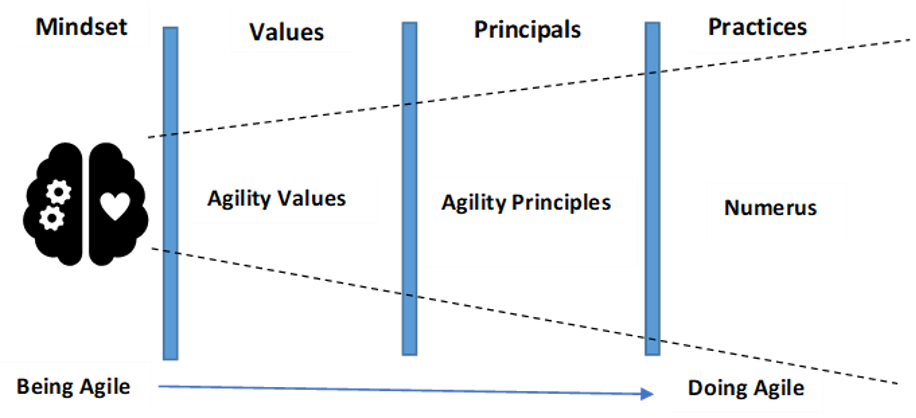
The notion of being agile means to have an agile mindset (growth mindset) which is the most difficult to achieve. It requires organizations and individuals to sacrifice command and control, which is an easy option, to trust and empowerment, which is a challenging option.
Agile vs. agility
The challenge in industry is not to confuse agile with agility. Both have a relationship with each other, but they are not the same. In fact, when we are talking about agile, we are focusing on method, frameworks, activities, and tools that we use to develop a product. On the other hand, agility is a way of thinking and working to grow our ability further and learn from changes. The focus of agility is not on tools or methods, but rather on people and their culture towards work. For example, being comfortable to make several attempts, fail more frequent and use several methods to find the right solution.
Agility is more than doing agile which means it is more than using several famous practices like Scrum, Kanban, XP etc. In fact, it requires organizations to understand that there's always room for improvement to adapt and react to changes in customer demand and expectation or market and technology changes in today's uncertain environment.
Unfortunately, many organizations have adopted the agile way of operation by using several tools, processes, and frameworks without understanding the importance and genuine meaning of agility. There are situations when the management insists that the company needs its teams to be agile, but their focus is on method, frameworks, and tools instead of the real meaning of agility which is to learn and to develop. According to Gunther Verheyen, this can lead to an illusion of agility. This phenomenon will block organizations in their growth and is painfully revealed when the deflation by reality hits hard, often after several years.
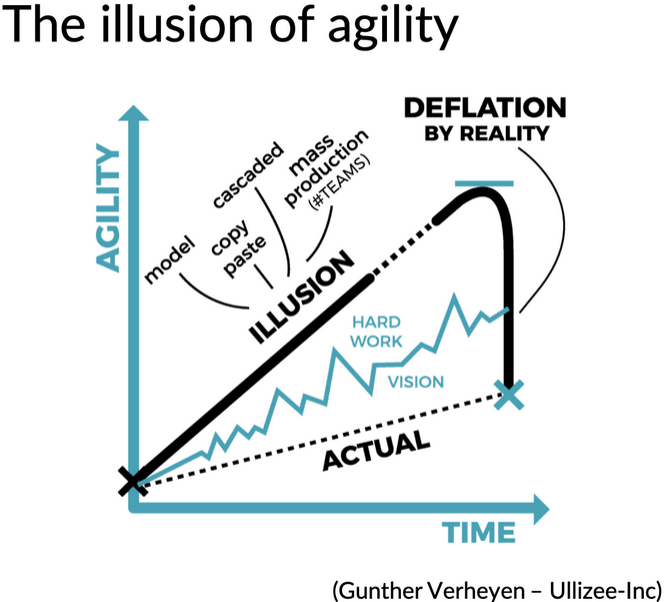
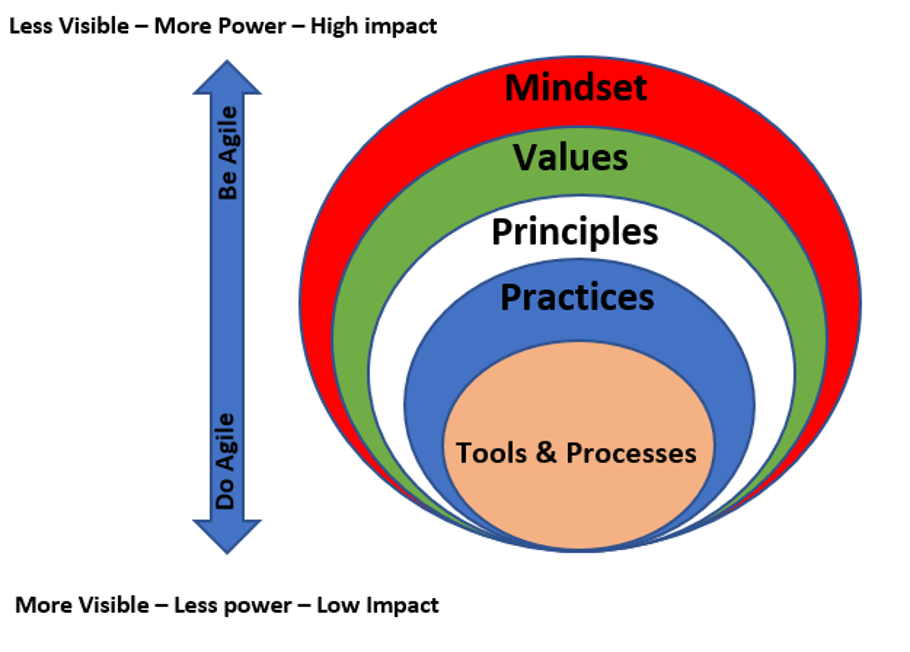
Basically, the whole goal of "agile" is achieving agility which means the ability to respond to internal and especially external changes and deliver value to customers quickly and more effective through learning and developing. Agile frameworks are horizontal tools, scripting behaviors without changing the view of yourself or the world. Whereas agility is a vertical development where organization members and leaders see new things that influence the way they show up; from reactive to creative, from habitual to intentional.
Therefore, the question is how can we achieve a vertical development by using the right horizontal tools? Before we get the answer to this question, we need to clarify the positions of "doing" and "being" and their interaction with each other.
Doing agile vs. being agile
Being agile is the overall goal in order to create a sustainable, growing, and always improving working environment. Therefore agility has no ending because there is always something to improve. Doing agile is applying the processes and practices to achieve that goal.
Experience shows that teams which are new to agile tend to "do agile" rather than to "be agile" in the beginning. The reason is they focus on implementing processes (for example scrum processes) to deliver fast results. But to be agile, we need not only the process, but also a shift in mindset and culture. With this mindset shift we can truly achieve a new level of communication and empowerment.
Agile adoption vs. agile transformation
The difference between "doing agile vs. being agile" can be illustrated by the concepts of "agile adoption" and "agile transformation".
The agile adoption in organizations is the introduction of agile processes and practices, and the allocation of time and resources for implementing those processes and practices and training people.
The agile transformation demands a fundamental change in peoples' mindset, thoughts and in the organizational culture as a whole in order to achieve a culture of learning, growing, and welcoming change. This transformation requires a strong foundation and continuity, as this cultural shift is a long-term process and no one-time effort.
The above discussion will open "systems thinking", where true agility lies. Agility and its practices need to be implemented horizontally and vertically in organizations in order to promote the ability to respond quickly to changes in an uncertain environment and to establish a genuine culture of continuous learning and improvement.